
Historically, banks have approached community development one activity at a time: an individual loan, an individual investment, an individual compliance exercise. Opportunity Zones offer a way to bring those activities together under a coordinated institutional strategy, one that creates economic value for the bank, its clients, its shareholders and the communities it serves.
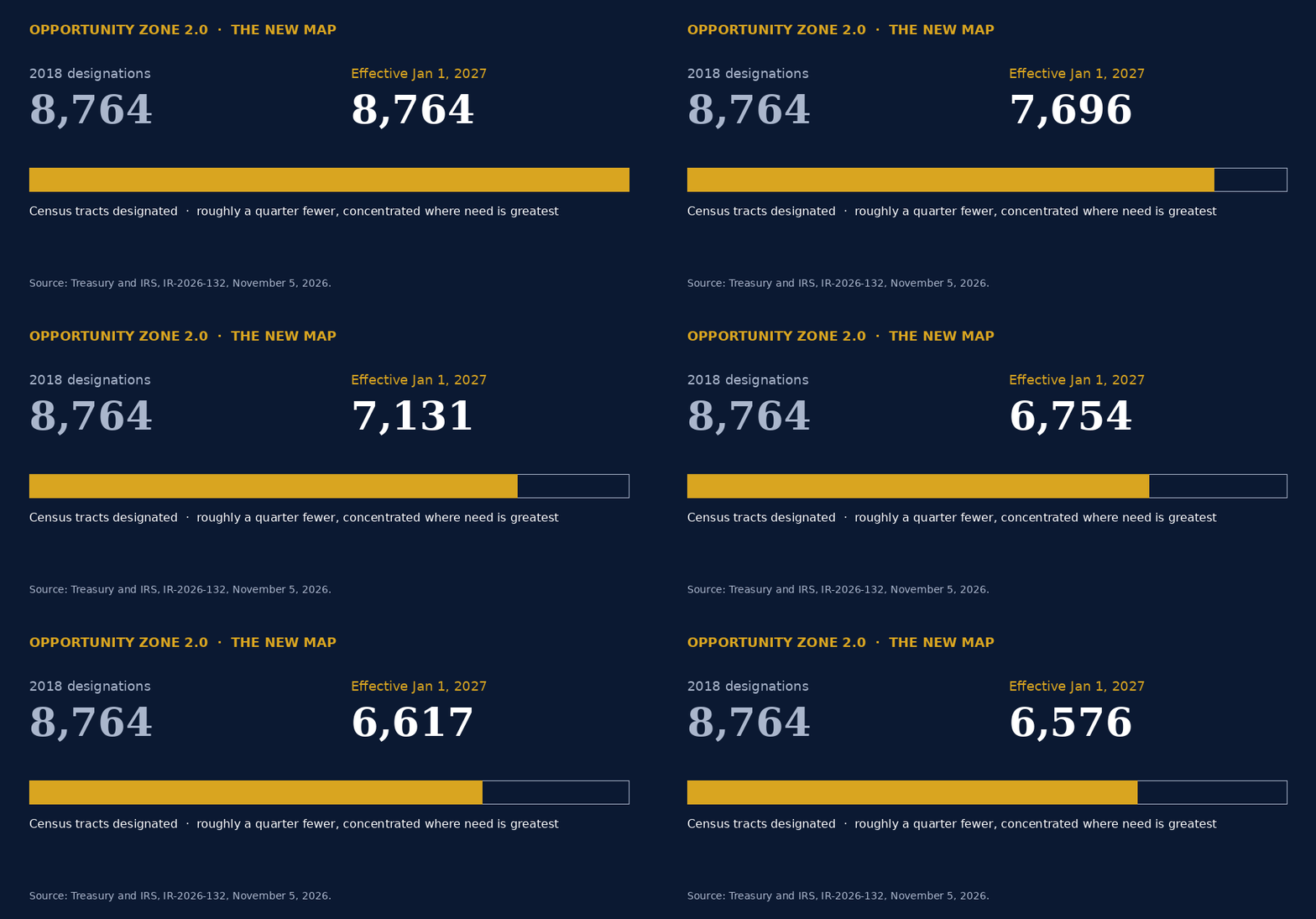
The timing matters. The One Big Beautiful Bill Act made the Opportunity Zone incentive permanent and replaced the original program's fixed end date with a ten-year redesignation cycle. On November 5, 2026, Treasury and the IRS announced the first round of new designations: 6,576 census tracts across all 50 states, the territories and the District of Columbia, effective January 1, 2027. Stricter eligibility, including a lower income threshold, cut the map by roughly a quarter from the 8,764 tracts designated in 2018, which concentrates the incentive in the communities with the greatest need.
For capital invested after December 31, 2026, the rules change as well. Eligible gains are deferred on a rolling five-year schedule from the date of investment; a five-year hold earns a 10% basis step-up, rising to 30% for qualified rural opportunity funds; and appreciation on investments held at least ten years can still be excluded from federal capital gains tax. For banks, permanence is the headline. It provides the long-term certainty needed to build a dedicated Opportunity Zone strategy instead of reacting deal by deal.
Section 01
Seven ways a bank can participate
The opportunity extends across seven distinct areas of banking. Each one is already familiar to the institution. What is new is the ability to point all seven at the same communities, businesses and investments.
Conceptual strategy. Independent underwriting, regulatory controls and fiduciary responsibilities remain intact for each activity. Source: Haven Senior Living Partners.
01Balance sheet investments
Subject to applicable banking regulations and investment authority, banks can deploy their own capital into Qualified Opportunity Funds (QOFs). A bank with an eligible capital gain can invest that gain in a QOF like any other investor. The potential benefits include:
- Long-term equity appreciation
- Tax-efficient management of eligible capital gains
- Diversification of investment income
- Participation in community revitalization
- Potential Community Reinvestment Act (CRA) consideration
- Strategic relationships with experienced fund sponsors
National banks may also use their public welfare investment authority where the underlying investments meet the applicable requirements.
02Commercial and real estate lending
Every well-capitalized Opportunity Zone development represents a potential commercial banking relationship, through construction financing, acquisition loans, permanent mortgages, bridge financing, equipment financing and working capital facilities. Because QOFs supply the patient equity that developers and businesses need, they can improve a project's capital structure and reduce leverage from the lender's perspective. Rather than waiting for loan requests, banks can cultivate relationships with Opportunity Zone fund managers to establish a recurring pipeline of lending opportunities.
03Private banking and wealth management
Opportunity Zones are a significant planning tool for clients with substantial capital gains, subject to investment suitability and applicable tax requirements. Likely candidates include business owners selling their companies, real estate investors, family offices, entrepreneurs, executives liquidating concentrated equity positions and other high-net-worth individuals. A wealth management division can maintain a vetted network of institutional-quality QOFs, so advisors can fold these investments into broader tax, estate and portfolio planning. The bank deepens client relationships and may earn additional advisory revenue, subject to securities laws, fiduciary obligations and conflict-of-interest controls.
04Community Reinvestment Act strategy
The CRA dimension is particularly compelling. Banks already carry regulatory responsibility to help meet the credit needs of the communities they serve, including low- and moderate-income neighborhoods. Opportunity Zone investments can complement that responsibility by supporting affordable and workforce housing, healthcare infrastructure, affordable senior housing & care, employment creation, rural economic development, small business expansion and the revitalization of distressed communities.
Designation is not qualification. An Opportunity Zone location does not by itself earn CRA consideration; the underlying activity must independently satisfy the applicable CRA requirements. The CRA framework is also in motion: the agencies continue to examine banks under the 1995-based regulations while the 2023 rule remains enjoined, and the OCC and FDIC proposed further revisions in August 2026. Banks should confirm treatment under the rules in force at the time of examination.
The larger shift is one of posture. Banks can move from a predominantly compliance-oriented CRA approach toward a proactive community investment strategy that pairs responsible financial returns with measurable community outcomes.
05Fund sponsorship and management
Banks with the appropriate experience, regulatory authority and risk management capability can sponsor or manage their own QOFs, serving as general partner or managing member, or enter strategic relationships with established third-party fund managers. The OCC has identified fund management as one avenue for bank participation. Depending on structure, this can add investment management revenue, broaden institutional investor relationships and give the bank earlier visibility into its community development pipeline.
06Treasury management and ancillary services
An Opportunity Zone project creates banking needs well beyond its initial financing. The fund, the development entities, the operating businesses, contractors and employees may all require treasury management, operating deposits, cash management, payment processing, escrow, payroll and commercial banking services. A single development can generate multiple banking relationships over its entire operating life.
07Community economic intelligence
Perhaps the least developed opportunity is the knowledge banks already hold. Banks see local business activity, capital requirements, demographic trends, credit demand, development pipelines and community needs. Combined with Opportunity Zone mapping, fund relationships and community development data, that knowledge can help a bank identify underserved markets where private capital can be deployed responsibly and productively. The bank becomes an active facilitator of regional economic development, not only a provider of capital.
Section 02
The structural problem is institutional fragmentation
All seven activities can involve the same communities, businesses and investments, yet inside most banks they are managed by separate departments, on separate systems, against separate objectives.
| Department | Primary objective | Where it meets an Opportunity Zone project |
|---|---|---|
| Corporate investments | Risk-adjusted investment returns | QOF equity and public welfare investments |
| Commercial lending | Loan origination and interest income | Construction, bridge and permanent debt |
| Wealth management | Client assets and financial planning | Client capital gains seeking a qualified fund |
| CRA department | Community development and regulatory performance | Qualifying community development activity |
| Treasury management | Deposits and service revenue | Fund, developer and operator accounts |
| Risk management | Institutional exposure and regulatory compliance | Investment authority and concentration limits |
| Executive leadership | Enterprise profitability and strategic growth | Whether the pieces add up to a strategy |
Illustrative; structures vary by institution. Source: Haven Senior Living Partners.
Each department may pursue legitimate objectives without fully seeing the economic opportunity being evaluated down the hall. The problem is rarely a shortage of capital, expertise or market demand. It is the absence of a coordinated institutional strategy that connects them.
Section 03
The senior housing & care opportunity
The integrated model is particularly compelling when applied to senior housing & care. An aging population, aging healthcare infrastructure, affordability pressure and the need for additional care capacity together create a long-duration opportunity for institutional capital. A well-located senior housing & care development or redevelopment within a Qualified Opportunity Zone can bring multiple banking divisions into the same transaction.
Consider an illustrative $30 million senior housing & care development.
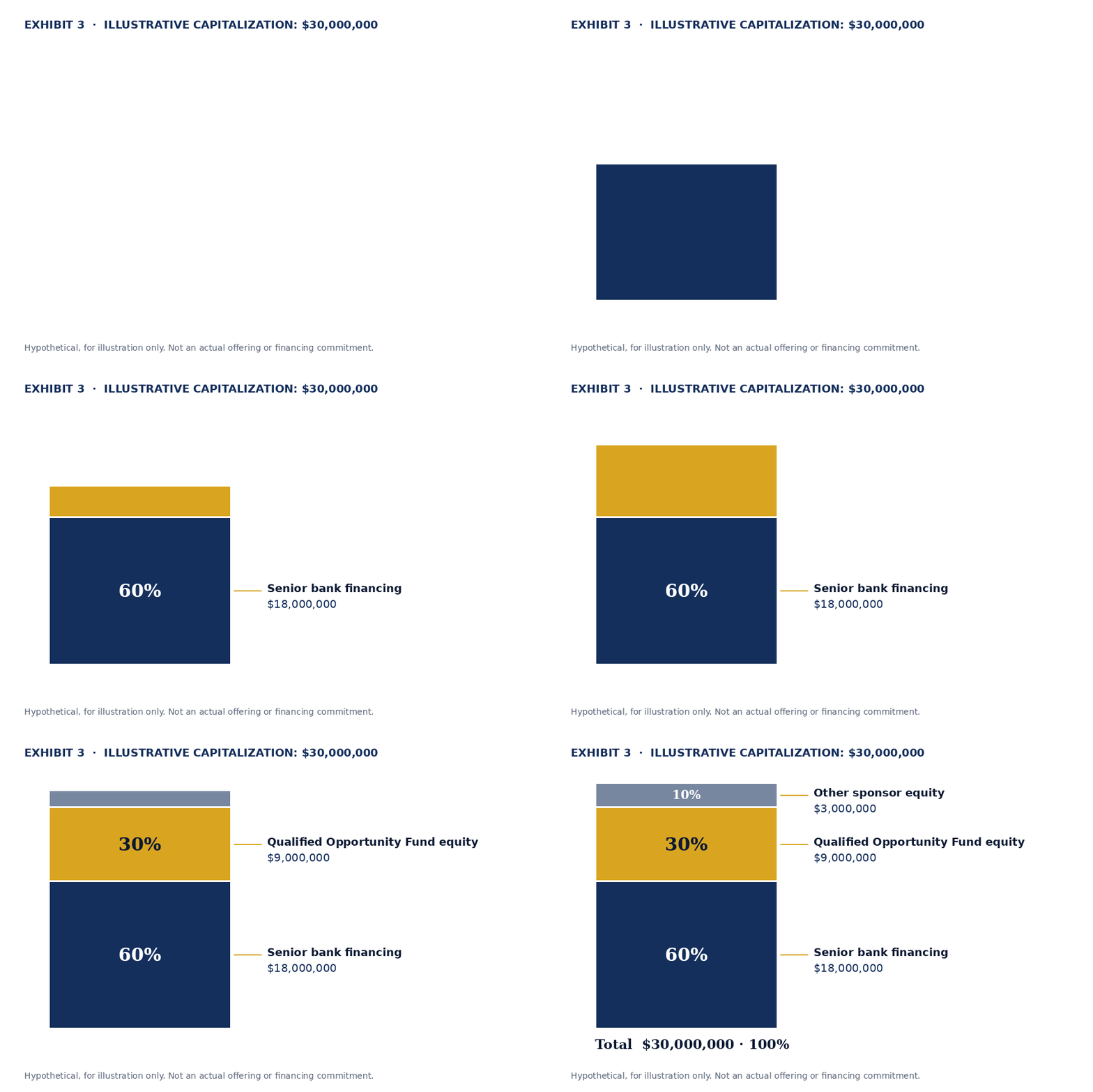
- Other sponsor equity
$3,000,000 · 10% - Qualified Opportunity Fund equity
$9,000,000 · 30%
Patient capital from investors with eligible gains - Senior bank financing
$18,000,000 · 60%
Construction loan, later permanent financing
Total capitalization $30,000,000 · 100%
Hypothetical capital structure for illustration only. It is not an actual offering, project or financing commitment. Source: Haven Senior Living Partners.
Within that single development, a bank could participate at seven distinct points.
| Banking activity | Opportunity |
|---|---|
| Commercial lending | $18 million senior lending relationship |
| Institutional investment | Permitted participation in the QOF equity |
| Wealth management | Eligible client participation in the fund |
| CRA | Potential consideration if community development requirements are satisfied |
| Treasury management | Fund and community operating accounts |
| Business banking | Relationships with operators, contractors and vendors |
| Permanent financing | Long-term refinancing relationship at stabilization |
Based on the hypothetical capitalization in Exhibit 3. Each activity remains subject to the bank's independent credit, investment and compliance approval. Source: Haven Senior Living Partners.
The community stands to gain additional senior care capacity, employment, investment in local infrastructure and potentially better access to affordable care. CRA eligibility, however, would have to be established through the populations actually served, affordability commitments, employment characteristics and other qualifying community benefits. The project's location alone is not enough.
Section 04
A different conversation with banks
For Haven Senior Living Partners, this thesis points to a larger role than that of a sponsor seeking project financing: a strategic partner to banking institutions, specializing in deploying institutional and private capital into senior housing & care within Qualified Opportunity Zones. Over time, that means a standing network of regional and national banking relationships, rather than approaching banks one transaction at a time.
It changes the question we bring to bank executives.
The usual question
Would your bank be interested in financing our next senior housing & care development?
The better question
Would your institution be interested in developing a coordinated Opportunity Zone investment, lending, wealth management and community development strategy focused on the growing needs of America's aging population?
That is a fundamentally different institutional relationship, and it needs a different set of people in the room. A conversation limited to a commercial loan officer can only produce a loan.
| Executive | Strategic relevance |
|---|---|
| Chief Executive Officer | Enterprise-wide strategy |
| Chief Investment Officer | Institutional capital allocation |
| Chief Lending Officer | Commercial loan pipeline |
| Head of Wealth Management | Private client investment opportunities |
| Chief CRA Officer | Qualified community development activities |
| Head of Community Development | Regional economic impact |
| Chief Risk Officer | Investment authority, concentration and risk controls |
| Chief Financial Officer | Capital efficiency and enterprise economics |
The objective is an executive-level discussion spanning multiple banking divisions. Source: Haven Senior Living Partners.
Proposed initiative
HSLP Strategic Banking Partnership Program
Connecting banking capital, private wealth and community development with the future of senior housing & care.
The value proposition to a banking institution would span:
- Origination of senior housing & care investment opportunities
- Qualified Opportunity Fund structuring and management
- Commercial lending opportunities
- Specialized senior housing & care underwriting expertise
- Wealth management investment opportunities
- Documentation of qualifying community development benefits
- Long-term asset performance and impact reporting
The guiding principle is stewardship: deploying capital responsibly, generating sustainable risk-adjusted returns and creating measurable benefits for the communities and older adults being served.
Section 05
The Opportunity Zone 2.0 thesis
Permanence lets banks and institutional fund sponsors think beyond individual transactions and build durable capital deployment strategies. The institutions that coordinate these activities well can generate multiple revenue streams, deepen client relationships, strengthen community development performance and build lasting regional investment networks.
The greatest opportunity may not be convincing banks to invest in Opportunity Zones. It may be helping banks recognize how many parts of their existing business can take part in a single, coordinated Opportunity Zone strategy.
Opportunity Zones should not be viewed simply as a tax incentive, a lending category or a CRA initiative. They are an opportunity to build an integrated institutional capital deployment strategy.
References
- U.S. Department of the Treasury and Internal Revenue Service, Treasury, IRS announce Opportunity Zones designations for over 6,500 communities across America, IR-2026-132, November 5, 2026.
- Greenberg Traurig, Treasury and IRS Publish Opportunity Zone 2.0 Designations: 6,576 Census Tracts Effective Jan. 1, 2027, November 2026.
- Novogradac, Treasury Announces Designation of More than 6,500 OZs Beginning Jan. 1, 2027, November 5, 2026.
- EY Tax News, IRS announces upcoming transitional guidance on Opportunity Zones (Notice 2026-40), June 25, 2026.
- Office of the Comptroller of the Currency, Leveraging Qualified Opportunity Funds in Bank Community Development Strategies, Community Developments Investments, January 2021.
- Office of the Comptroller of the Currency, Public Welfare Investments Resource Directory.
- Federal Reserve Bank of San Francisco, The Opportunity for Alignment: OZ Investments and the Community Reinvestment Act.
- Mayer Brown, Here We Go Again: The Latest Proposed Rule to Implement the Community Reinvestment Act, August 14, 2026.
Important disclosures
This article is for general information only. It is not an offer to sell or a solicitation of an offer to buy any security, and it is not tax, legal, accounting, investment or regulatory advice. Any offering by Haven Senior Living Partners, LLC is made only to accredited investors and only through its offering documents, which govern all terms.
The $30 million project, its capital structure and the participation points described are hypothetical and do not represent an actual offering, project or financing commitment. The HSLP Strategic Banking Partnership Program is a proposed strategy; nothing in this article asserts that any banking partnership, fund, or regulatory approval is in place.
Opportunity Zone tax benefits depend on satisfying statutory and regulatory requirements and on each investor's circumstances. CRA consideration is determined by a bank's regulators under the rules in effect and is never automatic. Bank participation in any activity described here is subject to applicable law, investment authority, safety-and-soundness review and the institution's own underwriting and fiduciary obligations. Real estate investments are illiquid and involve risk, including loss of principal. Readers should consult their own tax, legal and financial advisors.
© 2026 Haven Senior Living Partners, LLC · slinvestors.com