
The Long
Opening
A story about what it means to age into something — not away from it. About one woman, one village, and the season of life no one told us could be the fullest of all.
There is a particular kind of quiet
that isn't peace.
Eleanor Ashford knew the difference. She had known real peace — in the thirty-one years of a marriage that was genuinely good, in the summers when her children were young and the house was loud and the days were too short to hold everything they contained. That quiet had been the kind you stepped into deliberately, like a room you'd been looking forward to all day.
The quiet that came after Robert died was the other kind.
It arrived in stages, the way most losses do — first obvious, then subtle, then so deeply threaded through her daily life that she stopped noticing it was there. The house in Denton had always been two people's house. It had the proportions of a couple: two chairs by the window, two mugs on the highest shelf, the habit of buying the large carton of orange juice because Robert drank it every morning. She kept buying the large carton for fourteen months. Each time she poured it out before it finished, she did the arithmetic of the thing and felt it fresh.
Her daughter, Meg, visited as often as she could. Her son, David, called from Seattle every Sunday. The grandchildren were growing fast in the way grandchildren do — transforming between visits into new, almost unfamiliar versions of themselves, their interests shifting, their voices changing, their worlds filling up with people and concerns that had nothing to do with Denton or with her. She loved them fiercely and without condition, and she was quietly, guiltily grateful each Sunday evening when the house was hers again and she could stop performing wellness.
The performing was exhausting. No one required it — no one said, Eleanor, you must be fine — but she understood that her children carried a particular kind of worry about her, the weight of which she could feel across hundreds of miles of telephone line. So she told them she was doing well. She was getting out. She had joined a book club and found it pleasant. She was taking walks in the mornings.
Most of it was true. She was doing the things. She simply was not living them.
There is a version of life available to older women who are self-sufficient and externally fine that goes largely unexamined, because there is no crisis to examine. Eleanor's life had the proper shape. She paid her bills. Her garden was tended. She had her health, her faculties, her friends. By the standard measures she was doing extraordinarily well for seventy-four.
What she did not have — what she had been losing by increments for four years — was the sense that she was going toward something. That she was not simply inhabiting her days but moving through them, building toward something. That tomorrow would be, in some meaningful way, different from today.
The word for what was missing, she decided one January morning while pouring out a quarter carton of orange juice, was not company or comfort or even love. All of those were available to her in various forms.
The word was anticipation.
She did not have — what she had been losing by increments for four years — the sense that tomorrow would be different from today. The word for what was missing was not company or comfort or even love. The word was anticipation.
Meg was the one who first mentioned Haven. She had found it the way you find things in the age of searching — scrolling at eleven at night, looking for something that didn't have a name yet, hoping the algorithm knew what she was trying to say. She sent Eleanor the link with a message that said only: I think this is different. Will you at least look?
Eleanor looked. She read every word on the website, then read it again. She noticed that it did not talk about safety features or medical staffing ratios or memory care certifications, though presumably these things were true of it. It talked instead about mornings. About belonging. About the feeling of being expected somewhere. About a life that was still, in some essential sense, opening.
She closed the laptop and sat for a while in the chair by the window that had always been Robert's chair and thought about what it would mean to go.
She called Meg back in the morning and said: I want to see it.
Decatur in October
holds its light differently.
The sky over Wise County that morning was the particular blue of early autumn in North Texas — not the pale, bleached blue of August, but something deeper and more considered, the kind of sky that seems to have given the question of itself some serious thought and arrived at a confident answer. The mesquites along Highway 287 had just begun to turn, their small leaves catching and releasing the light in a way that felt almost deliberate.
Eleanor drove herself. Meg had offered to come, and she had said no, firmly but warmly, because she understood something important: that this decision required to be made alone in order to be made correctly. If Meg were there, Eleanor would be watching Meg's face for cues, reading her daughter's hope and adjusting her own reactions accordingly, and she would leave not knowing what she herself actually thought.
The entrance to Haven came up on her left between two lines of crepe myrtles — not yet the mature specimens they would eventually become, but already promising, their trunks pale and their branches reaching in the unhurried way of trees that have decided to commit to a particular piece of ground. A low stone marker carried the name in a typeface she found unexpectedly moving: quiet, confident, neither modest nor boastful.
She had expected to feel appraised upon arrival. She had toured two other places the previous year — not seriously, not with any real intention of moving, but because Meg had asked and she had wanted to be honest with herself about what was available. Both had been fine in the functional sense. Both had the smell of institutional cleaning products dressed up with candles. Both had greeted her as though she were an applicant to something, a candidate being evaluated for fit.
Haven's Director of Community Life, a woman named Catherine who wore no lanyard and shook Eleanor's hand with both of hers, said: I'm so glad you came. Come — let me show you where you'd live.
Not where you could live. Not where residents live.
Where you'd live.
Eleanor noted the verb tense. It was not an accident.
Both had greeted her as though she were an applicant.
Haven's director said: "Come — let me show you where you'd live."
Not "could live." Not "residents live."
"Where you'd live."
Eleanor noted the verb tense. It was not an accident.
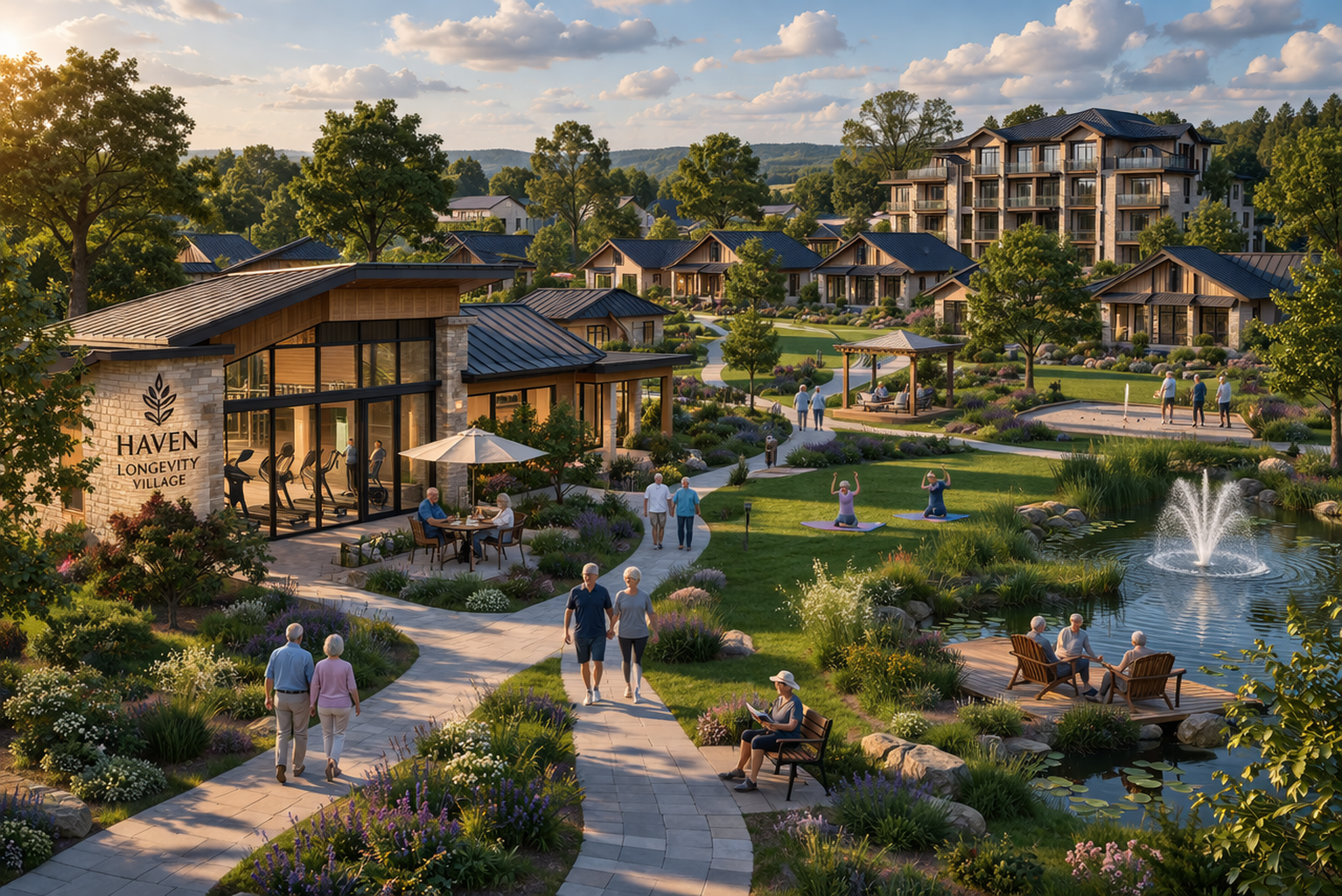
They walked the residential campus first — the broad, unhurried paths between the cottage neighborhoods, shaded by young oaks that would in twenty years make a cathedral of the streetscape. The architecture was residential in the truest sense: private front walks, garden beds that already showed signs of individual personality, a porch here with a reading chair, a window box there beginning to trail something purple and late-blooming. Nothing about it said facility. Everything about it said neighborhood.
They passed the Wellness Pavilion, which was still completing its interior finishes. Through the tall glass panels Eleanor could see the pool catching light, the fitness spaces, a dining room set for lunch with tablecloths and actual flowers on the tables. A woman inside, visible through the glass, was arranging a vase with the focused pleasure of someone who is doing something she genuinely loves.
"Who is that?" Eleanor asked.
"That's Rosalind," Catherine said. "She moved in six weeks ago. She brought her own vases."
Eleanor stood there a moment longer than necessary.
The cottage Catherine showed her last was the one she had saved for last on purpose — Eleanor understood this when she walked in. It faced southwest, with a covered porch that looked out over a garden being planted by someone with an eye for color and a proper understanding of what grows well in North Texas heat. The light inside was the afternoon light she had been chasing for years without knowing it.
She stood in the living room for a long time.
She thought of Robert. Not with grief, exactly — more with the feeling of consulting someone. He would have had opinions about the ceiling height and the placement of the windows. He would have walked the property lines immediately and calculated drainage. She could hear him almost perfectly and found, to her own surprise, that this was not a reason to leave but a reason to stay.
He would have liked it here, she thought. And then, more quietly: I will like it here.
She had not been taken seriously
by medicine in years.
She had not known this was what she had been experiencing until the day Dr. Vasquez, the Longevity Clinic's founding physician, spent the first forty minutes of their initial appointment asking her questions and writing down everything she said.
Not the questions she was used to. Not the questions designed to rule out the serious things quickly so you could get to the next patient. These were questions about her energy across the arc of a day. About her sleep. About what she noticed had changed in the last three years and what she had assumed was simply the inevitable arithmetic of getting older. About what she still wanted to do and what she had, quietly, stopped expecting of herself.
At the end of the appointment, Dr. Vasquez set down her pen and said: "I want to be honest with you. Several of the things you've described to me as inevitable are not inevitable. They are addressable. And the ones that aren't addressable — the ones that are simply part of aging — those can be worked with much more effectively than you've been led to believe."
Eleanor was seventy-four years old. She had seen roughly a dozen physicians in her adult life. Not one of them had said anything like that to her.
She went home to her cottage and called Meg, and Meg answered in the particular alert way she answered when she expected news. Eleanor said: "I think the doctor told me I wasn't done yet."
There was a long pause on the line. Then Meg said: "I know. That's what I was hoping."
Medicine that treats you
as the expert on
your own living.
Haven's Longevity Clinic is built on a single refusal: the refusal to accept that decline is the only story available to people in the later chapters of life. Its physicians practice preventive and functional longevity medicine — a discipline that asks not just what is wrong but what is possible, not just what to manage but what to reclaim.
The clinic serves both Haven residents and the broader Decatur community. It is the village's front door — the place where the brand's deepest convictions about human possibility become clinical practice. Where being taken seriously is not a courtesy but the foundational method.
The woman with the vases
turned out to be impossible to avoid.
This was, Eleanor came to understand, not accidental. Rosalind Yeh had spent thirty years as a landscape architect in Austin and had very strong opinions about the social function of threshold spaces — the zones between private and public, the covered walks and courtyard benches and corner tables in dining rooms where the possibility of conversation was built into the design of the thing. She had spent two months before moving into Haven studying its site plan and had chosen her apartment specifically for its position relative to three of these thresholds.
"I intend to know everyone here within a year," Rosalind told Eleanor at the table in the Pavilion dining room where they first sat down together, over coffee that was genuinely good. "Not in the way you know people in a care facility, where you learn their diagnoses and their difficult family situations by accident. In the way you know neighbors. Actually know them."
Eleanor looked at her. "You've thought about this."
"I've thought about everything," Rosalind said serenely. "I'm seventy-one. I have more time for thinking than I've ever had in my life, and fewer reasons to pretend I have less. Would you like more coffee?"
Eleanor would like more coffee. She would also, she realized with something close to surprise, like to hear what Rosalind thought about essentially everything.
It had been years since she had made a friend. Not a companion — companions she had; people to have lunch with, people to see films with, people to report the facts of her life to and receive the facts of theirs in return. A friend, in the older and more specific sense of the word: someone whose presence reorganized the quality of the day around it.
By the end of November, Rosalind and Eleanor had fallen into the habit of morning walks before breakfast — along the connector path that ran between the residential campus and the Longevity Commons, a route that took them past the young oaks and through the pocket garden that Rosalind had already made several unsolicited suggestions about to the head of landscape. They walked at a pace that allowed conversation and stopped for nothing unless something was worth stopping for, which, they found, was more often than they had expected.
"Do you miss Denton?" Rosalind asked one morning, in November, when the light was long and the air had finally gone cool enough to be pleasant.
Eleanor thought about it honestly. "I miss the person I was there," she said. "I don't miss the person I was becoming."
Rosalind nodded. They walked on.
"I miss the person I was there," Eleanor said. "I don't miss the person I was becoming."
Meg arrived on a Thursday,
expecting to be needed.
She had driven from Dallas with the particular vigilance she had brought to all her visits since Robert died — windows down briefly on the highway to clear her head, a list of practical questions she intended to ask, a carefully maintained openness to whatever she found. She had spent four years arriving at her mother's house and quickly, subtly taking the measure of things: How full is the refrigerator? Does she seem sharp? Has the garden gotten away from her?
She walked through the Haven gate in the late afternoon light of December and found her mother on the porch of the cottage with Rosalind, both of them with glasses of wine and an argument in progress about whether the young oak nearest the path was a Shumard or a Texas red. The argument was entirely good-natured. It had, Meg would learn, been ongoing for two weeks.
Eleanor stood when she saw Meg coming up the walk and opened her arms, and Meg walked into them and held on for a moment longer than usual. Over her mother's shoulder she saw the garden, which was wintered down but clearly tended with care. She saw the porch, which had accumulated the personal evidence of a life — a second reading chair, a small table with a lamp, a paperback face-down against the arm. She saw that her mother had put up a wreath.
"Come meet Rosalind," Eleanor said, and the way she said it — without preface, without explaining who Rosalind was or how they had met, the way you might say come meet someone whose place in your life requires no introduction — Meg felt something release in her chest that she had not known she had been holding.
That evening, after dinner in the Pavilion — a dinner her mother had clearly been looking forward to, at a table near the window she clearly considered hers — Meg sat in the second reading chair on the porch while Eleanor made tea inside. The community was settling into its evening rhythm. A couple walked the path with their dog. From somewhere across the campus came the sound of someone playing piano, unhurried and unhurried, filling the air pleasantly the way good music does when it is not performing for anyone.
Eleanor came back out with the tea and they sat together in the dark and the quiet, and Meg thought: This is the quiet that actually is peace.
After a while she said: "Mom, are you happy here?"
Eleanor was quiet for a moment in the particular way that meant she was taking the question seriously, not reaching for the easiest answer.
"I'm looking forward to things," she said finally. "I'm looking forward to tomorrow. I haven't been able to say that in a while."
Meg drove home the next day with the windows up.
Meg felt something release in her chest that she had not known she was holding —
the weight families carry for years, quietly,
about the people they love most.
The geography
was never incidental.
It is the thesis.
There is a particular character to the exurban Texas landscape that does something unusual for people who have spent decades in denser, faster places: it gives them room. Not just physical room — though 38 acres of open, deliberately designed campus does that — but a particular kind of internal room. The unhurried quality of Decatur. The community that still knows itself. The sky that goes on long enough to take seriously.
Haven Longevity Village was placed here because the place is part of the medicine. Because environments that allow for stillness without isolation, connection without crowding, and beauty without pretension are genuinely rare — and because Wise County is growing, its 55-and-older population expanding rapidly into a market that has never had a single purpose-built independent living unit, not one memory care bed designed for the twenty-first century, not one longevity clinic built around the question of what is actually possible.
The valley finds the people it is built for. Haven was built for people who still want to be in the world — fully, beautifully, with neighbors who know their names and mornings that feel like they are going somewhere.
In March the oaks
came in all at once.
This was one of the things Eleanor had learned about the Shumard oak — whose identity Rosalind had definitively confirmed by consulting three separate arborists and a university extension database and had then quietly declined to gloat about — that in good years it leafs out fast, the green arriving almost overnight, the canopy filling with a speed that feels like exuberance.
Eleanor was in her garden when it happened, or seemed to happen: Tuesday the branches were bare and Thursday they were full. She stood and looked up at it for a while and felt, in some imprecise but genuine way, that this was an event worth witnessing. That she had been here long enough to have a relationship with this particular tree. That she would be here for its next spring and the spring after that, and the knowledge of this felt unexpectedly rich.
In the eight months since she had moved to Haven, she had taken up watercolors at the insistence of a neighbor named Walter who was a retired civil engineer with a gift for color and no patience for excuses. She had begun attending what the Wellness Pavilion optimistically called Longevity Movement, which was not what you would call vigorous but was, she had to admit, making her back feel considerably better. She had become known in the dining room for her familiarity with Texas wine country — a subject she had pursued with the same systematic pleasure she brought to everything that genuinely interested her — and had twice been asked to suggest the dinner pairing, an honor she took with exactly the level of seriousness it deserved.
She had, at Dr. Vasquez's recommendation, agreed to a comprehensive recalibration of her sleep, her nutrition, and the hormonal picture that had been quietly distorting her energy for three years. She had not yet returned to the person she had been at sixty-two — she was not attempting to; that was not the project. She was attempting to be the best possible version of herself at seventy-four, which turned out to be a considerably more interesting project than she had expected when she arrived.
She had started buying the small carton of orange juice. It was precisely what she needed.
She had not returned to the person she had been at sixty-two — she was not attempting to. She was attempting to be the best possible version of herself at seventy-four. This turned out to be a considerably more interesting project than she had expected.
On the morning the oaks came in she walked to the courtyard in the center of the cottage neighborhood, where Rosalind had finally persuaded the grounds team to install a particular variety of native salvia she had been advocating for since October. It was blooming now, the spikes of blue-violet rising above the pale grasses in the morning light. Three other residents were already there: Walter with his sketchbook, a newer arrival named Patricia who was still learning the geography of the campus and carried a quality of alertness Eleanor recognized from her own first weeks, and an older man named James who came to the courtyard most mornings to read and whose name she kept meaning to properly learn.
She sat down on the bench across from the salvia and took out her own sketchbook — a habit she had not fully committed to but was beginning to, in the incremental way you commit to things when you are no longer in a hurry.
Walter looked over. "The oaks," he said.
"The oaks," she agreed.
Patricia asked what they meant by that, and Eleanor told her about the tree in her garden and the speed with which it had come in, and Patricia listened with the careful attention of someone who is new to a place and storing everything. James set down his book and made a brief, accurate observation about the light, which Eleanor considered genuinely interesting and which led, by the easy route these things take in a courtyard on a spring morning among people who have time and inclination, to a conversation that lasted until it was time for breakfast.
Walking to the Pavilion, Eleanor thought about what she had said to Meg in December.
I'm looking forward to tomorrow.
She was still looking forward to tomorrow. She had been looking forward to it, in some form, every day since November. She had looked forward to mornings — to the particular quality of light on the path, to Rosalind's argument of the week, to whatever was happening in the garden. She had looked forward to evenings — to the low conversations in the dining room, to the piano that someone played somewhere on Wednesday nights, to the porch in the dark with tea. She had looked forward to the doctor visits, which had come to feel not like a maintenance schedule but like an ongoing conversation about what was still possible.
She had even, recently, begun to look forward to the day after tomorrow. To what the salvia would look like in June. To whether the young Shumard would be large enough to shade the porch by September. To the wine she had on order from a Hill Country vineyard that the sommelier at the Pavilion had told her would be ready in the fall.
This, she thought, stepping into the warmth of the Pavilion where the smell of good coffee announced itself immediately and where Walter was already holding a table by the window and gesturing at her — this was not nothing. This was, in fact, precisely the thing.
What Haven
Is Really For
Eleanor's story is not remarkable. It does not involve a dramatic reversal or a miraculous recovery. It involves an environment that was built to honor the people living in it — that was designed, from its site plan to its staffing philosophy to its clinical practice, around the conviction that the later chapters of a life need not feel like a diminishment.
It involves a woman who was performing wellness and found a place where she no longer had to. Where the quiet, when it came, was genuinely the peaceful kind. Where tomorrow had something in it worth looking forward to.
That is Haven's entire thesis. Not the demographics, not the investment case, not the supply-demand gap or the unmet clinical need — though all of those things are true and matter. The thesis is simpler than any of them:
People deserve to live fully, at every age, in every season. The later chapters should still be lived.
And if you build a place worthy of that conviction — on 38 acres of open Texas sky, with paths designed for morning walks, a clinic built around what is possible, and neighbors worth knowing — then the people who need it will find it.
They will come in October when the light is long and the oaks are promising. They will stand in a cottage with afternoon light coming through the windows and think about the person who would have had opinions about the ceiling height. They will come back with something no one expected them to carry: anticipation.
"For we are God's handiwork,
created in Christ Jesus to do good works,
which God prepared in advance for us to do."